Business mailbox
 Developer Center


 Business mailbox
 Developer Center
WRC 2026|OYMotion CEO Neo Ni: Anchoring Engineering Implementation, Closing the Loop From Core Components to Real‑World Scenarios
2026.08.24


Release time:2026.06.17 16:35 Views: Author:
Back to list
Tactile sensing is fundamental to dexterous hands and the broader embodied AI sector. The core value of humanoid robots lies in universal adaptability and cross-scenario generalization, covering precision industrial assembly, household services, delicate manipulation and tool operation across diverse tasks. As the end effector responsible for all physical operations, dexterous hands define the upper limit of robotic functionality. Only with built-in tactile sensors can robots identify an object’s weight, softness, surface temperature and friction, enabling stable handling of fragile, smooth items like glass cups and achieving truly human-like fine manipulation.
The newly launched ROH-AP003 dexterous hand fully addresses this industry-wide demand. It integrates Melexis’ mature industrial-grade Tactaxis™ 3D magnetic tactile sensing technology with OYMotion’s full-stack R&D strengths in dexterous hand structural design, force control algorithms and system integration. This combination upgrades robotic hand perception from conventional single-axis force feedback to native full-dimensional tactile sensing, delivering neural-level tactile response comparable to human fingertips.
Stable operation and outstanding mass manufacturability powered by industrial sensing chips, supporting large-scale deployment at the 10,000-unit tier
Industry insiders widely recognize 2026 as the pivotal year when embodied AI transitions from technical R&D to large-scale commercialization. Historically, limitations of tactile sensors restricted high-quality tactile data collection, creating a major bottleneck for real-world dexterous hand adoption. Without accurate tactile signal input, AI models cannot master gentle, delicate gripping logic, confining even high-precision dexterous hands to lab environments.
The ROH-AP003 directly solves this industry pain point via upgraded tactile perception, equipping robotic hands to tackle a wide range of tasks requiring fine touch feedback. Its lightweight design delivers broad compatibility, supporting integration with all types of robotic arms and humanoid robot platforms. Target application scenarios include precision industrial assembly, flexible gripping, human-robot interaction, university research and vocational training. This launch expands OYMotion’s ROHand dexterous hand product portfolio, providing serialized solutions to meet diverse demands from downstream manufacturers.
High costs have long restricted the large-scale rollout of dexterous hands. According to GGII (Gaogong Robotics Industry Institute), mainstream linkage-type dexterous hands are currently priced at RMB 20,000–50,000, while tendon-driven and direct-drive models generally exceed RMB 100,000. Dexterous hands account for 20–25% of the total bill of materials for a complete humanoid robot — a higher proportion than the powertrain in traditional fuel vehicles.
Two core strategies drive cost reduction: cutting inherent hardware expenses through fully in-house independent R&D, and diluting marginal production costs via high-volume manufacturing.
OYMotion advances both strategies simultaneously. As one of the few domestic enterprises with full-stack independent R&D covering core components to algorithmic systems, the company controls costs through localized core technology development and systematic layout across supply chains, molds, self-developed upstream components and proprietary algorithms. Its products deliver superior cost performance versus imported alternatives while maintaining healthy gross profit margins.
The firm also boasts proven mass delivery capacity, ranking among China’s top-tier suppliers by dexterous hand shipment volume. “Ultimately, everything hinges on production scale,” Zhang Qi noted in a previous interview. “The market remains highly fragmented with numerous participants, many generating only tens of millions of RMB in annual revenue. After reserving reasonable gross profit from this revenue and fulfilling payments to upstream motor and component suppliers, individual manufacturers receive minimal order volumes. Hardware manufacturing is inherently a volume-driven business — without scale, there is negligible room for price optimization.”

During the roundtable forum held alongside the conference, Wang Zhenkun, CMO of OYMotion, shared further insights on supporting 10,000-unit mass production. He analyzed the current development status of domestic core components including miniature motors and sensors for dexterous hands, and dissected key challenges including cost reduction for mass production, industrial ecosystem collaboration, and the maturity of embodied AI control brains. Attendees collectively explored approaches to break down industry barriers between hardware, software, data and real-world scenarios, and discussed win-win upstream-downstream cooperation models with shared risks and shared benefits. While the path to mass production remains long, OYMotion leverages its full-stack proprietary technology and proven bulk delivery track record to deliver a replicable industrial blueprint for the widespread commercialization of embodied AI.
Beyond its flagship dexterous hand, OYMotion also showcased the OPENARM embodied dual-arm robot and compact humanoid robot calibration & training platform at the conference. These open platforms targeting robotics education, research validation and robot body assembly teaching demonstrate OYMotion’s comprehensive end-to-end R&D capabilities spanning core components to complete system platforms.
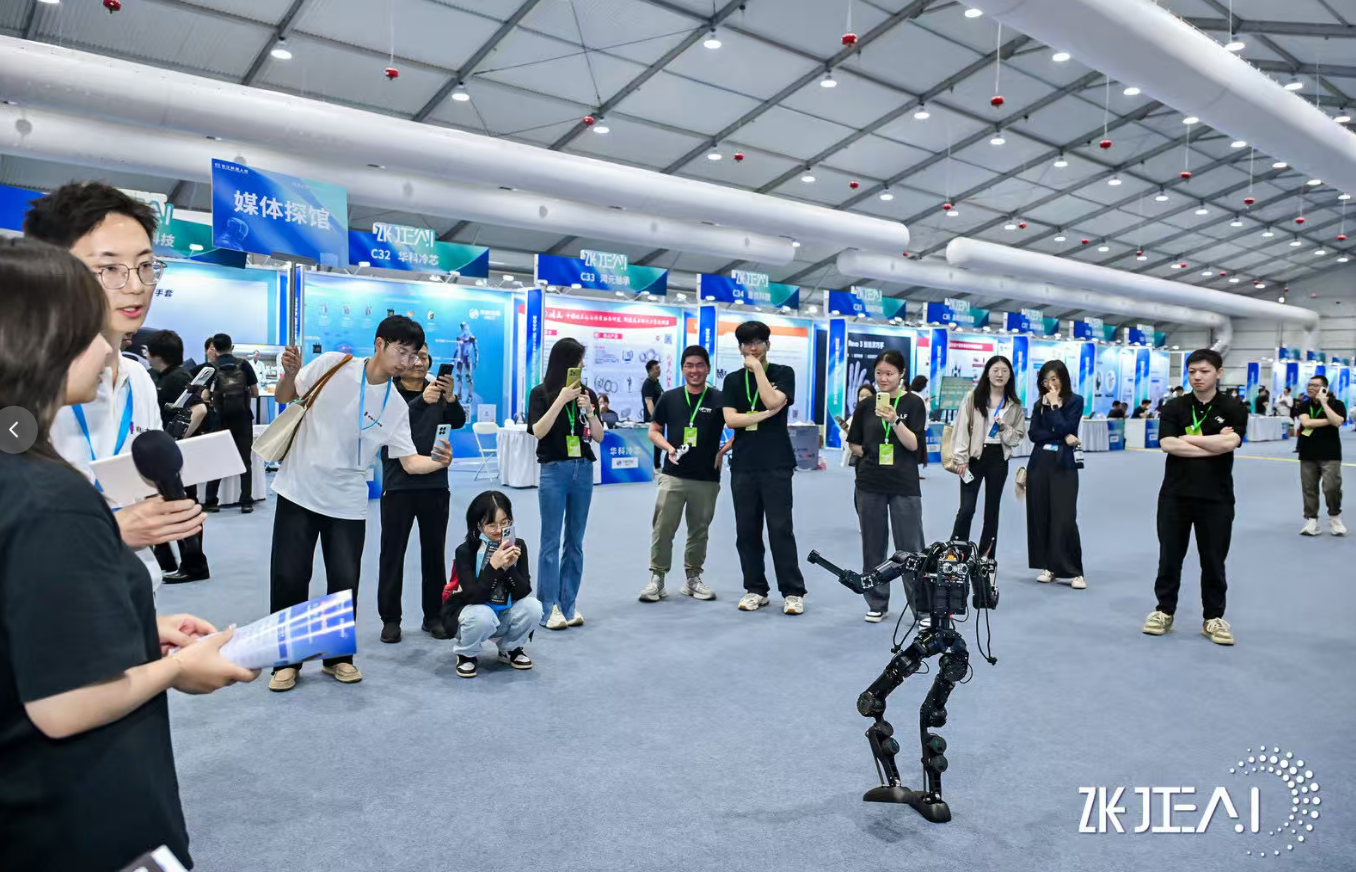
Founded in 2015 and headquartered in Shanghai Zhangjiang, OYMotion Technologies specializes in R&D and innovation of robotic end effectors and complete machine systems for the embodied AI sector. The company is committed to developing robotic solutions with human-comparable manipulation performance, tailored for differentiated real-world scenarios. Backed by robust bulk delivery capacity, high-precision force control technology and an open software-hardware architecture, OYMotion’s products are widely deployed in university research, vocational education, industrial automation and human-robot interaction, earning widespread recognition across the industry.
1234101.png)


5743082.png)
3217156.png)
2134943.png)
8471510.png)
7921439.png)

 Hotline
+86 2163210200
Email: info@oymotion.com
Sales: sales@oymotion.com
Support: faq@oymotion.com
Jobs: hr@oymotion.com
Alibaba:https://oymotion.en.alibaba.com/
Addr: No.788 Ziping Road, Pudong New Area, Shanghai China
Addr: Xihu International Plaza, 69 Wangjiang W. Rd, Shushan, Hefei
Addr: 5/F, Bldg B05, 82 Dinye Road, Zhuhai, PRC

WeChat:oymotion
Scan for more information